One hour in, and still no direction
Everyone is engaged. Every objection is fair. The hour ends without a direction — and the effort is what makes it look like progress.
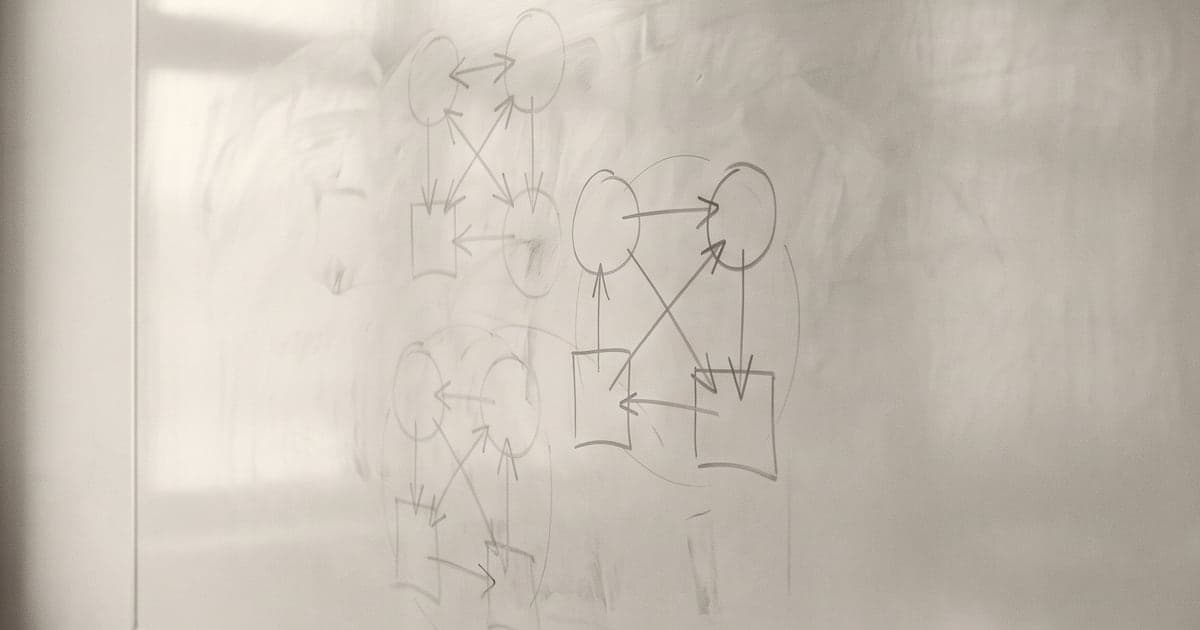
An hour in, someone gets up to redraw the diagram. It is the third version. The first two are still on the board, because each of them is still partly right and nobody wants to be the one who rubs them out.
The room is working. Nobody is on their phone. The objection about sequencing is a real objection. The question about who owns the second phase is a fair question, and the person asking it is not being difficult. Then someone says: before we go on, I want to come back to something we agreed at the start. That is fair too. It was agreed quickly.
The hour is gone and you have examined the problem from every side. You have not chosen a direction. Someone proposes taking it offline. Someone offers to write it up and circulate. Someone asks whether you have the data to settle this properly, and the room relaxes, because that is a responsible thing to want. The meeting ends when the next meeting needs the room.
Walking out, you would not call it a bad session. You would call it a hard one.
The quieter version, and this one
You know the quiet version of this. The meeting ends on time, nothing visibly goes wrong, everyone is smart and committed, and afterwards nothing has shifted.
This is the loud version, and it is the exact inversion. Nothing here is quiet. The engagement is real, the disagreement is real, the work is real — and the outcome is the same. Nothing was decided. Next week covers the same ground in different words.
There are other expressions: rehearsed alignment, polite divergence that never quite becomes disagreement, standoffs about whose call it actually is, the visible deadlock everybody in the room can name. They are not a taxonomy, and one conversation often moves between several. They are presentations of a single condition — a leadership conversation that does not move.
Effort is not the signal it looks like
In most of what a leadership team does, effort and progress travel together. You work harder on the deck, the deck gets better. You put more hours into the model, the model gets sharper.
A conversation is the exception. A room can generate an hour of high-quality effort and end exactly where it started, and — this is the part that matters — the effort itself is what stops anyone from seeing it. Exertion gets read as evidence. Nobody interrupts a hard-working meeting to ask whether it is going anywhere, because the room can point at the whiteboard.
The verdict on the way out is usually that it was a useful conversation. It was. Useful and conclusive are different properties, and only one of them was being tracked.
Why nothing closes
Where authority is asymmetric, questions close. Somebody with standing says we are going with this one, and the room moves on — not because everyone agrees, but because the decision has an owner and the owner has spoken.
A leadership team complicates that. The CEO may well be able to call it. But most people around the table hold legitimate authority over some part of the decision — finance over the exposure, product over what it does to the customer, operations over what execution will actually require. Each of them has good reason to reopen something that sounded settled, and is doing the job when they do.
So settlements stay provisional. The head of product reopening the sequencing question is not obstructing; she owns the part of it that the settlement quietly assumed. The room reopens faster than it closes, and closure is what it was convened to produce.
What the classic account reaches, and what it doesn't
The standard formulation is more than fifty years old. Ivan Steiner, synthesising laboratory studies of small groups, put it as subtraction: what a group actually produces is what the task and the people in it made possible, minus the losses in its process. The frame is useful because it separates two things that feel identical from inside the room — what the group had available to work with, and what happened to it in the working.
But it is retrospective. It names the gap between what the group could have produced and what its process produced. It does not tell you when that loss emerged inside the conversation.
Which makes it useless in the one place it would help: an hour in, from inside the chair.
The thing you asked for is the thing you already had
Kathleen Eisenhardt studied executive teams in microcomputer firms making strategic decisions in fast-moving markets, and published the result in 1989. The teams that decided fastest used more information, not less. They considered more alternatives, and considered them alongside each other rather than one at a time. Speed did not come from narrowing what was on the table.
Set that beside the standard fixes for a session like the one above: tighter agendas, fewer options on the slide, pre-reads circulated Friday, harder timeboxes. Each is a real improvement to how a meeting is run. None of them is aimed at what separated Eisenhardt's fast teams, which was not how much they had to process.
And notice what the room asked for on its way out. More data. The deferral requests additional quantities of the one thing that was not in short supply.
What the hour got spent on
One more finding, from the experimental literature on group deliberation as Cass Sunstein and Reid Hastie assembled it: discussion gravitates toward what everyone in the room already knows. Shared information gets airtime, while something held by one person often stays with that person, unmentioned, right through a long and conscientious debate. So an hour can be spent in good faith re-circulating common ground. From inside it feels like thoroughness.
The obvious fix, and its floor
The obvious fix is that somebody decides. Eisenhardt found this in the fast teams too — they sought consensus, and where consensus did not arrive, the leader called it.
Look at what that does. It solves one problem: the meeting no longer ends undecided. It does not tell you whether the group converged. Whether a direction the room chose and a direction the room received hold up the same way afterwards is a question the meeting itself cannot answer. The fallback puts a floor under how long a decision can stay open. That is not the same as the room arriving somewhere together.
Running out of time is not running out of convergence
A meeting ends because the room is booked. That is all that happened. A room that has finished and a room that has stopped look identical from the corridor, and only one of them has a direction.
And the pattern does not change with length. A two-day offsite runs the same way, with better coffee. Which is the tell: if more time were the answer, the offsite would have settled it.
What was missing an hour in was not more minutes. Go back through the session and almost every contribution holds up. The sequencing objection was correct. The ownership question was fair. The decision that got reopened deserved reopening. Every one of them was valid, and not one of them closed anything. That is the specific thing that happened in your hour — a continuous supply of good contributions, none of which settled.
From inside the conversation, that is difficult to see. It arrives as fatigue, or as mild irritation at whoever reopened the question. Neither tells you what the group is doing that keeps the question open.
An hour into your next working session, the useful question is not whether the room is working. It is — visibly, audibly, and that is precisely what makes this hard to see.
The question is what has closed since you sat down. If the honest answer is nothing, then running out of time was not the problem.
References
Steiner, I. D. (1972). Group Process and Productivity. Academic Press.
Eisenhardt, K. M. (1989). Making fast strategic decisions in high-velocity environments. Academy of Management Journal, 32(3), 543–576. 10.5465/256434
Sunstein, C. R., & Hastie, R. (2015). Wiser: Getting Beyond Groupthink to Make Groups Smarter. Harvard Business Review Press.