Are We Missing the Forest for the Trees?
AI doesn’t just make work faster — it exposes that how we organise collective intelligence is obsolete. The shift from information management to intelligence architecture.
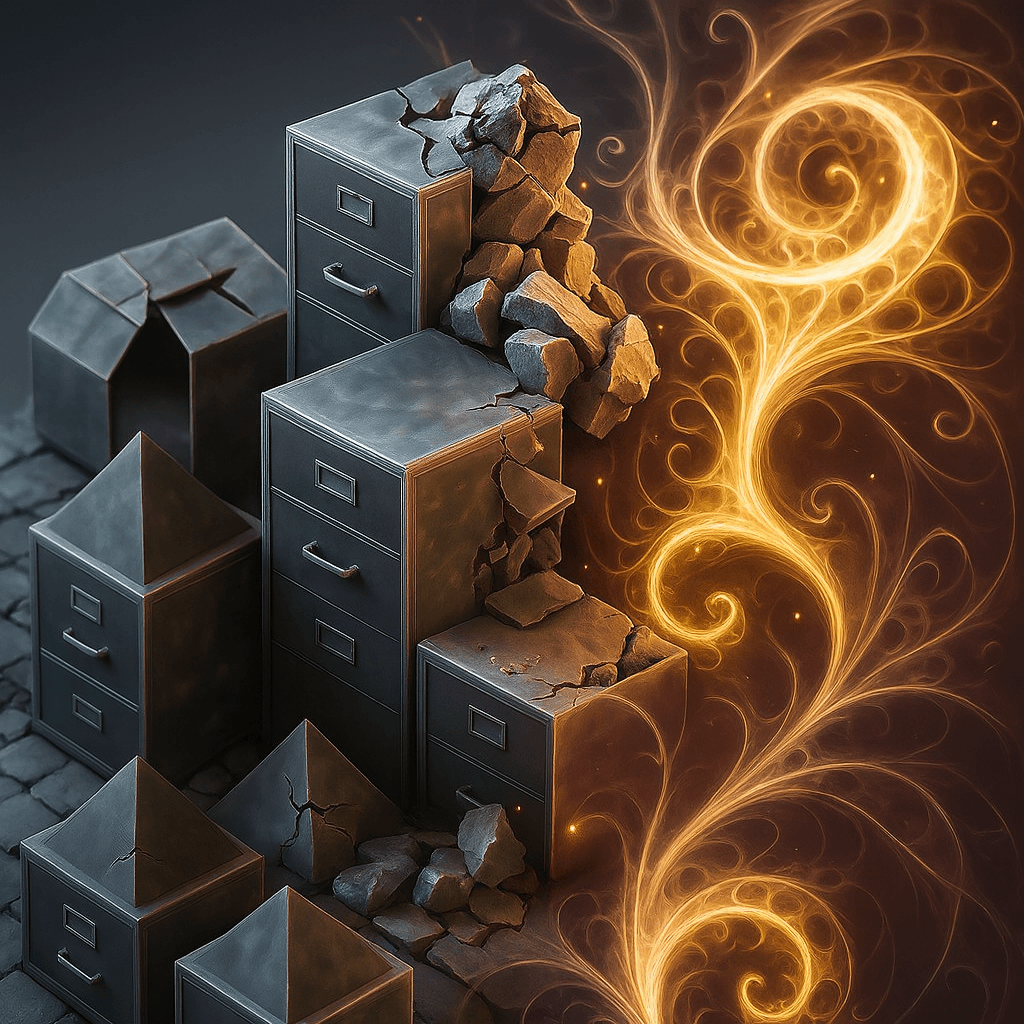
We are surrounded by unprecedented tools. Algorithms are about to discover new medicines. Systems composing music in minutes. Machines mapping human genomes while most of us are still catching up on yesterday’s email. And yet, with all this capability, our default instinct is to apply these tools to the same tired systems we’ve used for a century.
Here’s what everyone misses: these new tools don’t just enhance how humans execute tasks — they reveal that the way we’ve been organising human intelligence itself is obsolete.
The Electric Motor Revolution Nobody Talks About
In the 19th century, factories were built around massive centralised steam engines. When electric motors arrived, factory owners did the obvious thing — they replaced the steam engines with electric ones. Same layout. Same constraints. Slightly better efficiency.
Then someone realised electric motors could be placed anywhere. Suddenly, the entire architecture of manufacturing transformed. Production lines were redesigned. Workflows reimagined. The constraint had never been the power source — it had been the assumption that power must be centralised.
This is exactly where we are with AI today. But the shift is even more fundamental than most realise.
The Real Disruption Isn’t Technical — It’s Cognitive
Most companies are asking: “How can we use AI to do our work faster?”
But AI doesn’t just accelerate work. It exposes something we’ve been blind to for decades: the way we organise collective human intelligence is fundamentally inefficient.
Think about how your team actually works: information siloed, decisions requiring synchronous meetings where most people don’t need to be there, context lost in handoffs, alignment through repetition instead of resonance.
We accepted this as “how business works.” But it’s not. It’s how business works when human cognitive bandwidth is the bottleneck.
AI removes that bottleneck. And when you remove the constraint, the entire system needs to be redesigned.
From Information Management to Intelligence Architecture
Here’s the shift most companies are missing:
Industrial-era companies were built to manage information flow.
AI-native companies are built to orchestrate intelligence flow.
The difference is profound:
| Information Systems | Intelligence Systems |
| Store and retrieve data | Generate and evolve understanding |
| Optimise workflows | Dissolve unnecessary steps |
| Schedule alignment meetings | Maintain continuous coherence |
| Broadcast decisions | Transmit context |
| Manage individual tasks | Orchestrate collective sensing |
When your system is built to manage information, you ask: “How can AI help us process faster?”
When your system is built to orchestrate intelligence, you ask: “What becomes possible when our collective cognitive capacity is no longer limited by meeting schedules and email threads?”
What Collective Intelligence Actually Looks Like
Imagine your team operating like a single distributed intelligence:
- Context doesn’t need to be “shared” — it’s ambient and accessible
- Decisions don’t require meetings — they emerge from continuous sensing
- AI doesn’t wait for prompts — it anticipates what the system needs next
- Innovation isn’t brainstormed — it surfaces from pattern recognition across the entire knowledge field
This isn’t science fiction. This is what happens when you stop using AI as a productivity tool and start using it as cognitive infrastructure.
We call this architecture “consciousness-native” — not because it’s mystical, but because it’s designed around how collective intelligence actually operates when you remove the friction of industrial-age coordination systems.
The Shift Required
This transformation requires more than new software. It requires a different mental model of what a company is.
Most leaders still think of their organisation as:
- A collection of individuals executing tasks
- Connected by processes and communication protocols
- Departments that hoard knowledge
- Meetings to synchronise what AI could coordinate continuously
- Innovation locked in individual heads
But consciousness-native organisations operate as:
- A unified intelligence field where individual contributions amplify collective capacity
- Fluid role structures that adapt to what the system needs
- Continuous ambient awareness across the entire organisation
- AI that doesn’t just answer questions but helps the collective mind think better
- Value creation that happens at the speed of coherence, not approval chains
The challenge isn’t technical. The technology exists.
The challenge is seeing that the old model — optimised for information management — can’t simply be upgraded. It needs to be replaced.
What Comes Next
We’re not building better productivity tools.
We’re designing the first intelligence operating systems — architectures that allow human and artificial intelligence to function as a coherent, evolving whole rather than as separate agents passing messages back and forth.
The companies that understand this shift won’t just win their industries. They’ll redefine what industries can be.
If you’re ready to stop optimising the past and start building from a fundamentally different operating principle — from information management to intelligence architecture — let’s talk.
The old frame is collapsing. The new one is being built right now.
The question is: are you designing it, or waiting for someone else to?