How Old Thought Patterns Affect New Technology
Why do breakthrough technologies bend under yesterday’s logic? We approach AI with mental scripts forged for scarcity, not abundance.
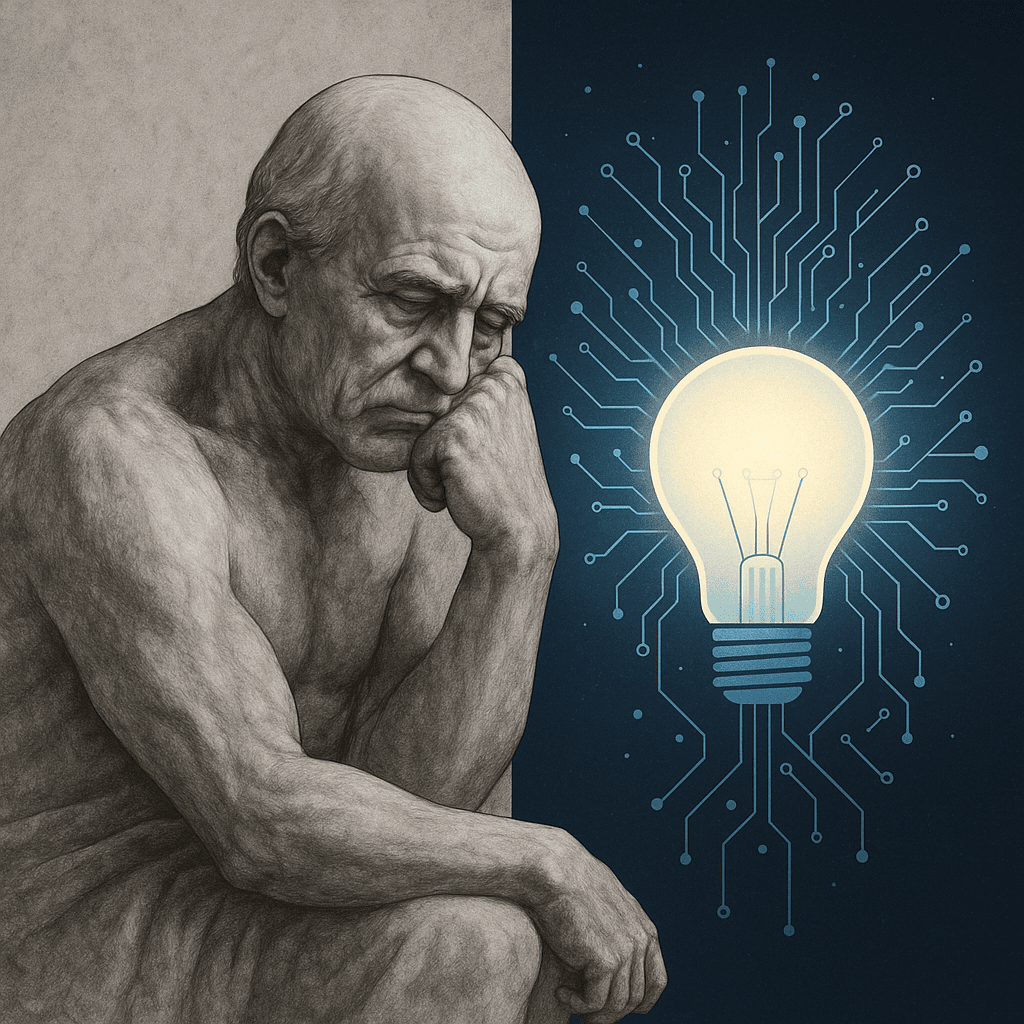
Humanity stands at the edge of extraordinary technological possibility, yet we drag chains we barely recognise. Every breakthrough we celebrate — artificial intelligence, renewable energy, bioengineering — arrives in a world still ruled by instincts forged millennia ago. We invent the future, then try to run it with minds built for survival in caves and walled cities. The mismatch is not subtle. It quietly shapes everything from policy decisions to how teams adopt new tools.
A strange irony unfolds here. The very patterns that helped us endure scarcity now block us from abundance. We approach quantum computing with the same mental scripts used to ration grain in Roman storehouses. We design networks of information but govern them like feudal estates. The result? A cycle where each new wave of technology promises liberation yet bends under the weight of yesterday’s logic.
Why are we still living in a survival mindset? Are we really any different now than in Roman times? We create civilisation based on what we know, which then limits the ability to utilise new technology to its fullest extent. We first need to change our mindset before we can change how we operate. “We cannot solve problems by using the same kind of thinking we used when we created them,” — Albert Einstein
This becomes clearest during moments of stress. When systems falter, when markets wobble, leaders rarely ask what is newly possible. They default to what once worked. The reflex to consolidate power, hoard resources, and enforce order echoes across centuries. The fear behind it is ancient. We still respond to disruption like villagers facing a coming storm.
Breaking the Survival Mindset of Industrial System Collapse
Why do we cling so tightly to survival thinking when the conditions of survival have shifted? Technology has removed much of the scarcity that defined human life for thousands of years. Yet fear lingers like background radiation. The story we tell ourselves — that life is a constant struggle against threat — persists even when abundance is present. We can 3D print organs, communicate across continents in seconds, and still act as though every decision is life or death.
History shadows us. The fall of empires, the rise of tyrannies, the memory of famine and war — these remain coded into culture. Roman roads carried soldiers and grain. Today’s fibre optics carry data and capital. But the psychology is similar: secure your tribe, outpace rivals, control the flow. Technology changes, but the human story we write with it barely does.
Breaking free requires more than better tools. It demands an entirely new orientation. To access what is possible, we must stop treating technology as an extension of our fear and start engaging it as an amplifier of trust, creativity, and shared intelligence. Otherwise, we simply build faster chariots instead of imagining flight.
The Shadow of Old Civilisations
Consider the myth of progress: that each generation rises beyond the limitations of the last. Look closely and it frays. The architecture of modern civilisation still mirrors ancient power hierarchies. Centralised control, competitive scarcity, zero-sum thinking — these patterns echo from Rome to the British Empire to today’s corporate boardrooms. We celebrate innovation but rarely interrogate the operating system it runs on.
When artificial intelligence learns from our behaviour, it inherits our biases. When social networks scale, they amplify both connection and division. These are not flaws in the technology itself but reflections of the frameworks we project onto it. Until we change the story, new tools will simply replicate old mistakes at speed and scale.
Culture shifts slowly. Biology even slower. But awareness can pivot in an instant. Teams that question not just what they build but how they think while building unlock possibilities that feel almost miraculous. This is the edge where true breakthroughs occur: when technology stops serving fear and begins serving life.
Breaking the survival mindset is about learning to sense possibilities together, rather than dictate them alone. This is where the shift to living systems intelligence begins. Where creativity flows from alignment rather than anxiety.
When Technology Outpaces Imagination
The challenge today is not technological capability but human imagination. Our tools evolve exponentially, but our thought patterns crawl. We mistake faster machines for smarter societies. We optimise processes while neglecting purpose. The result is efficiency without wisdom.
Nature offers a different model. Forests organise without central command. Ant colonies build cities without blueprints. Intelligence emerges not from dominance but from connection. Imagine applying that principle to human technology. Imagine networks designed to distribute power, not concentrate it. Systems that thrive on diversity rather than uniformity. Such systems would not just manage complexity. They would learn from it.
This shift shows up in how companies run meetings, how governments design policy, how individuals make choices. The question is whether we will cling to fear long enough to let potential slip by, or whether we will learn to trust what wants to emerge. Those who sense it early will navigate chaos not by controlling it but by harmonising with it.